Why do capable girls sometimes hold themselves back academically, and what school structures help them step forward?
The problem
Many high-achieving girls feel a quiet tension between doing well and fitting in. Some downplay their success, avoid putting their hand up, or question their ability even when they are doing brilliantly. Over time, that can shape the subjects they choose, the risks they take, and how far they let themselves aim.
Why it matters
When capable girls make themselves smaller, they lose opportunities, and schools lose the chance to see what these students can really do. Small changes to school culture can help girls step forward with confidence.
What the project does
No Small Ambition combines an anonymous survey, interviews and classroom observation to understand what is happening, then designs practical support, mentoring, academic-identity workshops and an IB transition toolkit, and measures whether it helps.
The name
No Small Ambition works two ways: the ambition girls are entitled to hold for themselves, and the ambition great schools hold for their girls.
How it all connects
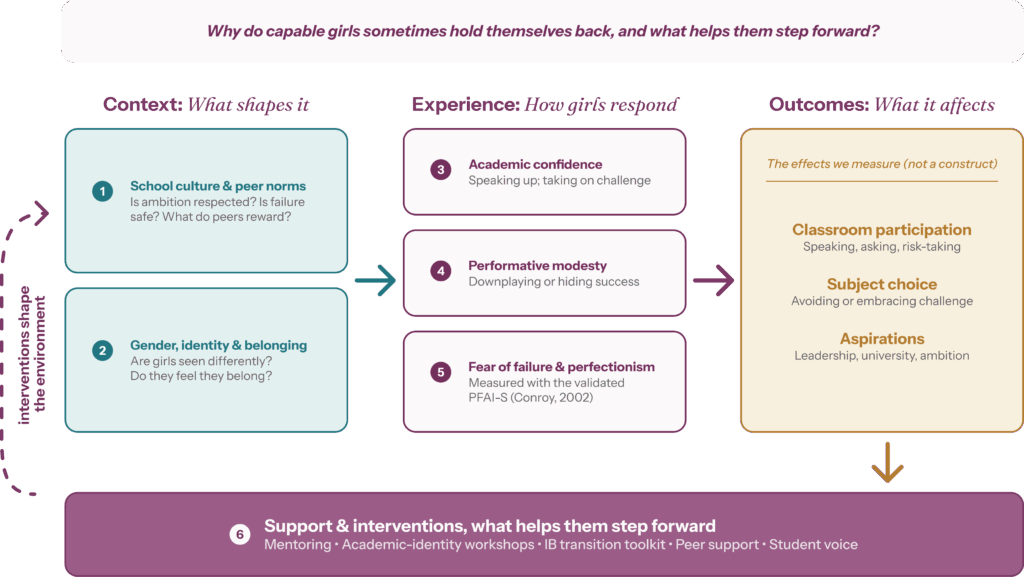
the six constructs used in the survey (1 to 6) and how they flow to outcomes
How the research works
No Small Ambition uses a mixed-method design: an anonymous survey for broad patterns, interviews for depth, and observation of how confidence and belonging show up in real classrooms.
The six constructs
Academic confidence and participation
Downplaying or hiding success
Fear of failure and perfectionism
School culture and peer norms
Gender, identity and belonging
The support students would find helpful
Every question in the survey maps to exactly one of these.
A validated measure
The fear-of-failure section uses the Performance Failure Appraisal Inventory – Short Form (PFAI-S; Conroy, 2002), an established scale. These results can be compared to published research and reported with a known reliability.
Ethics
The survey is anonymous and voluntary, students can skip any question, and it is run with school approval and wellbeing safeguards in place.
With thanks to Prof. Sarah Hetrick, whose feedback shaped the research design.